
Laboratory diagnostics: Actinobacillus pleuropneumoniae (APP)

What laboratory diagnostic methods can I use to APP? Which one should I choose according to the situation? How do I interpret the results?
Welcome to 333
Connect, share, and interact with the largest community of professionals in the swine industry.
Celebrating 203,875Users on 333!
Sign up Already a member? 3tres3.com
Professional Pig Community
3tres3.com
Professional Pig Community
 My account

The pig sector events all around the world

Un resumen semanal de las novedades de 3tres3 Argentina
Boletín de noticias sobre el mundo del porcino
Information on pig health: news and articles, disease guide, diagnostic tool, clinical cases, atlas of pathology…

Simulator that calculates the amount of drug to add to the water when using a flow dispenser.

Definition for the most commonly used pig terms

Description of the most important diseases and conditions in pigs

Pig disease diagnostic tool

Images of major swine diseases

All the information about ASF: how to recognize the disease, how it is transmitted, pictures of lesions, latest news, guides, etc.

A visual and practical step-by-step guide on how to perform a necropsy on a pig.

Biocheck.UGent is an independent, risk-based, scientific scoring system for assessing the quality of your on-farm biosecurity.

All the information on Foot and Mouth Disease in pigs: how to recognize the disease, how it is transmitted, images of lesions, latest news, guides,...
Un resumen semanal de las novedades de 3tres3 Argentina
Articles on nutrition and pig feeding, characteristics of raw materials and additives for pig feed. Prices of raw materials
Definition for the most commonly used pig terms

Technical sheets of the main raw materials and additives used in swine feed. They include a comparison of nutritional values from various sources, product

Global production and trade data for the most important raw materials

Latest quotations for the main commodities used in pig feed. Historical graphs with the pig price and estimated feed price.
Un resumen semanal de las novedades de 3tres3 Argentina
Articles on genetic improvement and pig reproduction
Definition for the most commonly used pig terms

Compare production data, calculate the number of sow, nursery, and finishing spaces, and visualize your tasks on the work schedule by type of BMS.

Tool that allows you to calculate the replacement rate in your farm
Un resumen semanal de las novedades de 3tres3 Argentina
Information on the design of pig farm facilities, equipment and farm
Simulator that calculates the amount of drug to add to the water when using a flow dispenser.
Definition for the most commonly used pig terms
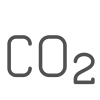
Environmental Footprint Calculator along the pork value chain.
Biocheck.UGent is an independent, risk-based, scientific scoring system for assessing the quality of your on-farm biosecurity.
Un resumen semanal de las novedades de 3tres3 Argentina
News and economic comments on the market situation of pork and raw materials. Prices of pig and raw materials. Census, pork production and trade data

The latest slaughter pig prices in the most important pig markets. Check the evolution of the historical prices in charts and in several currencies.

Figures & trends in pig numbers, pork production and pork trade.
Global production and trade data for the most important raw materials
Latest quotations for the main commodities used in pig feed. Historical graphs with the pig price and estimated feed price.
Un resumen semanal de las novedades de 3tres3 Argentina
Información semanal del precio del cerdo y las materias primas
Management, pig farm management, work planning in each production stage
Definition for the most commonly used pig terms
Compare production data, calculate the number of sow, nursery, and finishing spaces, and visualize your tasks on the work schedule by type of BMS.
Tool that allows you to calculate the replacement rate in your farm
Un resumen semanal de las novedades de 3tres3 Argentina
Pleuropneumonia is a disease of bacterial origin with a high respiratory impact. The production of toxins can often cause sudden death with nasal hemorrhage.
The Actinobacillus pleuropneumoniae (App) bacteria, has at least fifteen different serotypes, some of which do not produce any clinical signs, while others may cause serious disease. The serotypes vary depending on the country. Serotypes 1,2,5,9 and 11 are normally quite virulent, while serotypes 3 and 7 are quite mild. The App is transported in the tonsils and the upper respiratory tract. It is transmitted in short distances through aerosol and only survives outside the pig for a few days.
The organism may affect the pig from weaning to slaughter, but normally it affects pigs 8 to 16 weeks old. The incubation period is very short; as short as 3 hours. The toxins produced by the bacteria can cause severe pulmonary damage. Infected animals can carry the organism during several months without showing any symptom.
App is not very common in sows, unless they did not had previous contact, or unless the subclinical disease is triggered by PRRS or influenza.
Symptoms
All ages
Causes / contributing factors
Diagnosis
Based on the farm history, clinical signs, post mortem examination including slaughterhouse exams and culture of the organism. Pulmonary lesions are very typical. Serology may be used to identify serotypes, but its interpretation can be difficult due to cross reactivity between serotypes.
App must be differentiated from enzootic pneumonia, PRRS, influenza, and pneumonia caused by Salmonella choleraesuis.
Control / prevention
Due to the acute course of the disease, it is important to identify the clinical cases quickly and inject the affected animals. The infected pigs stop eating and/or drinking, so medicating trough feed or water is not an adequate treatment method. App is sensitive to a wide range of antibiotics. The following antibiotics are effective.
It is important to determine the time the outbreak can take place and administer strategic medication before it appears.
Medication used in feed during the risk period include:
Preventive medication in feed is not always effective, probably due to the speed of the disease’s onset, and the quick loss of appetite.
Water medication during the risk period may result more effective to control the disease. Animals should be treated during 4 to 7 days. Use the same antibiotics used in feed.
In acute outbreaks, the population at risk should be examined three times a day in order to identify the disease as soon as possible. It might be necessary to inject or medicate the water of all the group. The decision to inject depends on the balance between the result obtained when injecting, and the risk of increasing the number of pigs presenting the disease due to the stress caused by the associated handling.
There are several vaccines available. These vaccines should include the specific strain of the outbreak.
Select replacement animals from herds negative to App.

What laboratory diagnostic methods can I use to APP? Which one should I choose according to the situation? How do I interpret the results?
